Delivery App Menu Markups: What the New Olo App Means for Restaurants
Want to build your own app?
Start Building FreeShort answer: On 20 October 2026 Olo, the company that runs online ordering for more than 800 restaurant brands, launched its own consumer app in the US. Its promise is simple: customers pay the same menu prices they would pay in the restaurant, plus a flat 5% network fee shown up front, instead of the inflated item prices common on DoorDash and Uber Eats. If you run a small restaurant, you probably cannot join the Olo App yet. It launched with about 250 brands that already use Olo. The useful part for you is the pricing argument behind it, because it is the same argument for your own ordering app or website.
This guide explains what a menu markup is and why restaurants add one, what the Olo App actually does, how the numbers compare for a typical order, and what to change in your own channels this month. If you are still deciding whether to leave the marketplaces at all, read why restaurants are building their own delivery app first.
What a menu markup is, and why restaurants add one
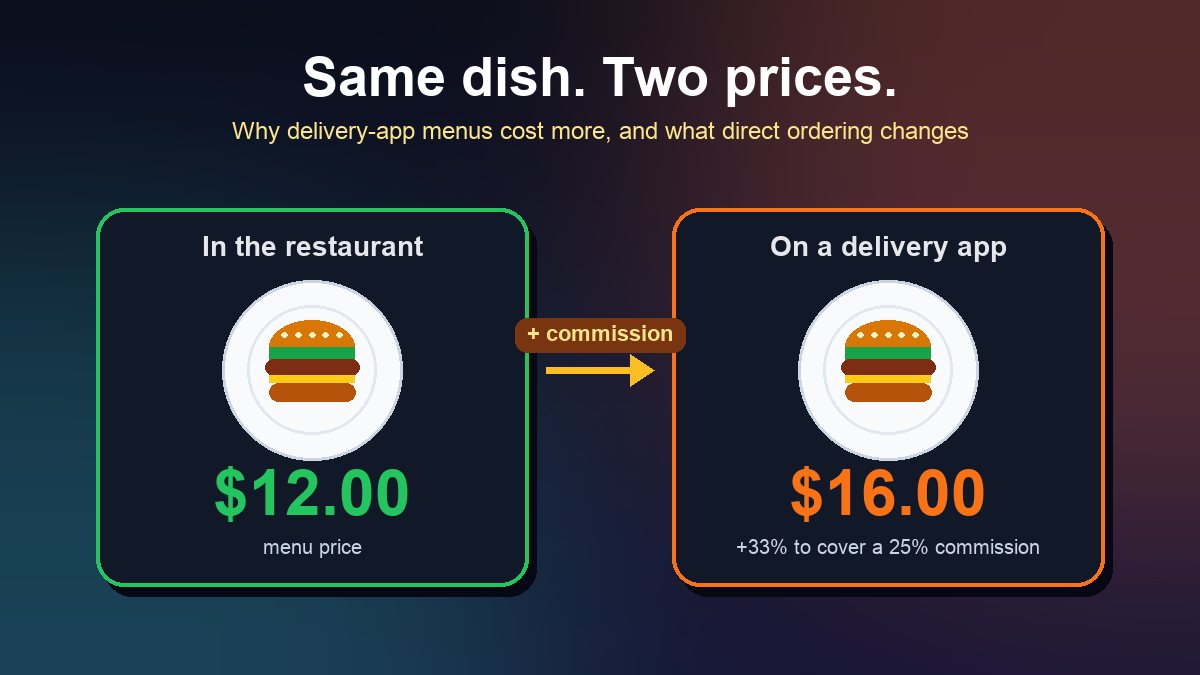
A menu markup is when the same burger costs more on a delivery app than at your counter. Customers often blame the app. In most cases the restaurant set the higher price to cover the commission the marketplace takes on every order.
The commissions are public. On their US merchant pricing pages, checked on 24 October 2026:
- DoorDash lists Basic at 15% on delivery orders, Plus at 25% and Premier at 30%, with pickup orders at 6% on each plan.
- Uber Eats lists marketplace fees of 20% (Lite), 25% (Plus) and 30% (Premium). Its pickup fee is 7% if you prove your in-app pickup prices match your in-store prices, and 10% if you do not.
To keep the same money from a sale after a commission, you divide your in-store price by what is left after the commission. A $12 dish on a 25% plan has to be listed at $16 to leave you $12. On a 30% plan it has to be about $17.14. That is a 33% to 43% higher price for the customer, before any delivery or service fee from the app.
| Commission on the order | Listed price needed to keep $12 | Markup the customer sees |
|---|---|---|
| 15% | $14.12 | +18% |
| 20% | $15.00 | +25% |
| 25% | $16.00 | +33% |
| 30% | $17.14 | +43% |
Most restaurants do not mark up that much. They split the cost and keep a lower margin on delivery. But customers do not see the maths. They only see that the app is expensive. According to a survey of 1,010 US adults that Olo commissioned in October 2026, 74% expect delivery fees, but only 27% expect individual menu items to cost more on third-party apps. That gap is what Olo is going after.
What the Olo App is
Olo has run ordering behind the scenes for years. If you have ordered from a chain's own website or app, there is a good chance Olo processed it. According to its launch announcement, it handles more than 3.5 million orders a day across 800+ brands and about 90,000 locations. The new app puts those restaurants in one consumer app, available on iPhone and Android since 20 October.
What the launch materials and the coverage in Restaurant Dive and WIRED confirm:
- In-store menu prices. Restaurants show the same prices as at the counter. Olo puts the saving at 15% to 30% per menu item compared with marked-up marketplace prices.
- A 5% network fee paid by the customer. CEO Noah Glass told Restaurant Dive the fee is shown at the top of the menu and again at checkout, not mixed into taxes and service fees.
- Delivery still costs extra. Customers pay whatever delivery charge the restaurant sets. Pickup orders skip it.
- Drivers come from existing networks. Olo has no drivers of its own. Its Dispatch tool asks the delivery services that cover the restaurant for quotes and picks the best one, so the driver may still be from DoorDash or Uber.
- The restaurant keeps the customer. Glass says an order reaches the restaurant exactly as if it came through the brand's own ordering channel, so the restaurant keeps the first-party customer data.
- No sponsored listings. Customers follow the restaurants they like, and the feed has no paid placements.
At launch it covers about 250 brands, including Five Guys, Waffle House, Noodles & Company and First Watch, and roughly 20,000 locations. Olo plans to add more of its own customers first and open the app to the wider industry later. It has not given a date for that.
How the numbers compare on one order
Take a $30 order at in-store prices, from a restaurant on a 20% marketplace plan that fully offsets the commission with a 25% markup. This is an example only. Real markups and fees vary by restaurant, city and plan.
| Where the customer orders | Food subtotal | Platform fee on the food | What the restaurant keeps from the food |
|---|---|---|---|
| Marketplace app, marked-up menu | $37.50 | App's own service fee (varies) | $30.00 after a 20% commission |
| Olo App, in-store menu | $30.00 | 5% network fee (about $1.50 if charged on the food) | Depends on the restaurant's Olo agreement |
| The restaurant's own app or website | $30.00 | None, apart from card processing | About $30.00, minus card fees and the ordering software |
Delivery charges come on top in all three cases. Two points stand out. First, the customer on the marketplace pays about $7.50 more for the same food, and the restaurant is no better off. Second, Olo has not published what restaurants pay per order on the new app. Its launch materials talk about the 5% customer fee. Do not assume it is free for the restaurant. Ask your Olo account manager if you are an Olo customer.
What it means if you run a small restaurant
You do not need to be on the Olo App to use its main idea. Customers are learning that marketplace menus are marked up, and some will look for a cheaper way to order from you. Make sure that cheaper way exists and that they can find it.
1. Write down what each channel really costs
List every place you take orders: counter, phone, your website, your app, each marketplace. Next to each one, write the commission or fee, card processing and any monthly software fee. Many owners find they are on a higher plan than they need, or paying for marketing features they never use. Moving from a 30% plan to a 15% plan changes how much you need to mark up.
2. Make your own channel the cheapest, and say so
If your marketplace menu is 20% higher, your direct menu should be at in-store prices, and your takeaway bags, receipts and Google profile should say so. A plain line works: "Order direct at in-store prices." Customers who already know your food are the easiest ones to move. A dedicated ordering app or a fast mobile ordering page does the job. The features worth having are in must-have restaurant app features, and the main options are compared in best app builders for restaurants.
3. Push pickup harder than delivery
Pickup is where the cost gap is largest. DoorDash charges 6% on pickup orders and Uber Eats 7%, but on your own channel pickup costs you only card processing, and the customer pays no delivery fee. A pickup-only discount or a free item on the third direct order usually costs less than a marketplace commission. A simple points scheme works well here. See using a loyalty app to bring customers back.
4. Keep the customer relationship
Olo's pitch to restaurants is that the order arrives as if it came through their own channel, so they keep the customer data. On a marketplace you usually get much less. When customers order direct, you get their name, order history and permission to contact them again. That makes a short, useful message possible, for example "your usual order is back on the menu", sent through a push notification strategy that customers do not mute.
5. Keep the marketplaces for discovery, and price them deliberately
Marketplaces still bring in customers who have never heard of you, and you may need them. Treat them as a paid ad channel with a known cost. Choose the lowest plan that still gets you visible, decide on purpose how much of the commission you pass on, and keep the same markup across items so the gap is easy to explain. If you list on Uber Eats with in-store pickup prices, submit the proof so you pay the 7% pickup fee instead of 10%.
What this does not change
- Someone still pays for delivery. Olo uses the same driver networks, so delivery fees stay. The saving is on the menu price.
- Your own app needs promotion. A direct ordering app nobody knows about earns nothing. Use QR codes on tables and bags (see QR code menus and dedicated apps), staff mentions at the counter and a clear button on your Google profile.
- It is US-only for now. The launch covers US restaurants. In India the same logic applies to Swiggy and Zomato. Check the commission in your partner agreement and price your direct channel against it.
FAQ
Can my independent restaurant join the Olo App?
Not right away in most cases. The app launched with about 250 brands that already use Olo's ordering platform. Olo says it will add more of its roughly 90,000 locations first and open the app to the wider restaurant industry later, without a date yet.
Is building my own ordering app worth it with only a few orders a day?
Do the maths for your own numbers. Multiply the orders you could move to your own app each month by the average order value and your current commission rate. Compare that with the monthly cost of the app and card processing. Keep in mind that moving even regulars who order once or twice a week adds up quickly. For taking payments in your app, see adding payment processing to your app.
Sources: Olo, Introducing the Olo App (press release, 20 October 2026); Restaurant Dive, Olo wants to kill delivery commissions (21 October 2026); WIRED, This New Food Delivery App Could Be the Antidote to Menu Markups (20 October 2026); DoorDash merchant pricing and Uber Eats merchant pricing (checked 24 October 2026). Example figures are illustrations, not quotes.